
Why Is Textile Machinery Important for Global Buyers?
Textile machinery shapes how fibers become consistent, usable fabrics at commercial scale. For global buyers, equipment choices affect output, quality, labor needs, energy use, and delivery schedules. A loom, knitting machine, dyeing line, or finishing unit can influence the entire production floor. Small differences in speed or tension control may lead to uneven fabric, excess waste, or costly downtime.
Buying equipment is not simply a matter of choosing the fastest model. Buyers need to compare the machine’s intended materials, production volume, control systems, maintenance needs, and fit with existing lines. A machine demonstrated with one cotton blend may perform differently with recycled yarn or a heavier weave. Ask for documented specifications, sample runs, service details, and realistic operating costs. It matters. Supplier support can be as important as the machine itself, especially when replacement parts or skilled technicians are difficult to access. Consider operator training, installation time, and energy consumption before committing.
Global sourcing brings practical questions. Shipping dimensions, commissioning, language support, and local service coverage can affect the true purchase price. Not always. A lower quote may lead to longer stoppages if support is limited. Textile machinery decisions deserve careful comparison, not assumptions based on brochures alone. The sections ahead examine machine types, buying criteria, efficiency, maintenance, and supplier evaluation. They also consider where automation helps—and where a simpler setup may prove more dependable. Some answers depend on factory conditions; that uncertainty should be stated, not hidden.
What Is Textile Machinery and Which Production Stages Does It Support?
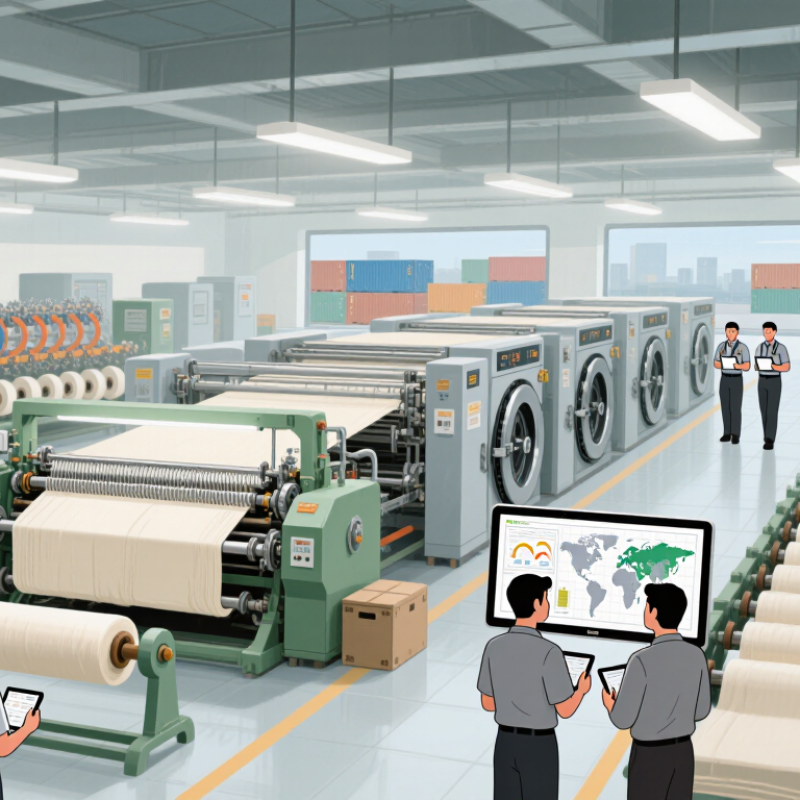
Textile machinery covers the equipment that turns fiber into yarn, fabric, and finished goods. At the fiber stage, bale openers loosen compressed cotton or synthetic fiber, while carding machines align fibers into a soft web. Spinning frames then twist that web into yarn. Small settings matter. A slight tension change can cause weak yarn or frequent breaks.
In fabric production, looms interlace yarns, while knitting machines form loops. Wet-processing equipment washes, dyes, and finishes fabric; stenters control width and dry it with heat. Cutting and sewing machines shape fabric into garments or home textiles. Inspection systems can detect uneven dyeing, holes, or measurement errors before goods leave the mill. Textile Exchange’s Materials Market Report 2024 estimates that global fiber production reached 124 million tonnes in 2023. It projects production could reach about 160 million tonnes by 2030.
That growing volume makes machinery relevant across the whole production chain, not just on the factory floor. The right setup affects output, consistency, labor needs, and material loss. Yet machinery cannot fix every process problem. Poor fiber quality, unclear specifications, or rushed changeovers still create defects. The sequence is not perfectly linear, either: mills may send fabric back for rework, which costs time and energy. Buyers should match machine capability to product type, expected volume, and the plant’s actual operating skills.
| Production Stage | Typical Machinery | What the Machinery Does | Why It Matters to Global Buyers | Key Purchasing Considerations |
|---|---|---|---|---|
| Fiber preparation | Opening, cleaning, blending, and carding machines | Opens and cleans staple fibers, blends different fiber types when required, and aligns fibers into a more uniform web or sliver. | Consistent preparation helps reduce variation in downstream yarn and fabric production. Equipment configuration depends on the fiber type and the required product. | Fiber compatibility, contamination removal, production capacity, waste handling, and ease of cleaning. |
| Spinning | Drawing frames, combing machines, roving frames, ring-spinning machines, and rotor-spinning machines | Drafts and twists fibers into yarn. Different spinning systems produce yarns with different characteristics and are suited to different fibers, counts, and production needs. | Yarn properties influence fabric strength, appearance, handle, and suitability for end uses such as apparel, home textiles, and industrial products. | Yarn specifications, fiber compatibility, achievable output, energy use, automation, and availability of maintenance support. |
| Yarn preparation | Winding, warping, and sizing machines | Packages yarn for later processing, arranges warp yarns in parallel, and applies protective sizing to many warp yarns before weaving. | Well-prepared yarn can support smoother fabric formation and help limit yarn breakage during weaving. | Package format, yarn tension control, sizing requirements, process integration, and compatibility with the intended loom setup. |
| Fabric formation: weaving | Shuttle, rapier, projectile, and air-jet looms | Interlaces warp and weft yarns to form woven fabric. Loom types differ in insertion method, operating requirements, and suitable applications. | Weaving equipment affects fabric construction, achievable designs, production efficiency, and the range of fabrics a mill can make. | Fabric width and construction, yarn range, required flexibility, compressed-air needs for air-jet systems, and spare-parts access. |
| Fabric formation: knitting | Weft-knitting and warp-knitting machines | Forms fabric by interlooping yarns. Weft knitting commonly creates fabrics used in garments, while warp knitting is used for products including certain apparel and technical fabrics. | Knitting enables stretch and varied fabric structures that are important for many clothing, furnishing, and technical-textile applications. | Machine gauge, working width, stitch and pattern requirements, yarn compatibility, and the intended fabric application. |
| Wet processing and dyeing | Preparation, dyeing, washing, and rinsing equipment | Processes textile materials with water and chemicals to prepare, color, or clean fibers, yarns, or fabrics. The exact process depends on the material and product. | Color consistency and process control affect product quality. Wet processing also requires careful management of water, heat, chemicals, and wastewater. | Material and dye-process compatibility, batch or continuous operation, water and energy use, process controls, and wastewater-treatment requirements. |
| Finishing | Stenters, drying ranges, compactors, calenders, and coating or laminating lines | Dries, sets dimensions, changes surface characteristics, or applies functional layers to fabric, depending on the finishing process. | Finishing can determine fabric width, appearance, handle, dimensional stability, and functional performance required by the buyer’s market. | Desired finish, fabric width and construction, temperature control, line speed, emissions controls, and process repeatability. |
| Inspection and converting | Fabric inspection, measuring, slitting, and rolling machines | Checks fabric for visible defects, measures length, and prepares material into rolls or narrower widths for shipment or further manufacturing. | Reliable inspection and roll preparation support quality control, traceability, and smoother handling by downstream manufacturers. | Inspection method, defect-marking system, measurement accuracy, roll specifications, and integration with production records. |
| Across the production line | Material-handling systems, sensors, control systems, and maintenance tools | Move materials between processes, monitor operating conditions, coordinate machine functions, and support equipment upkeep. | Production performance depends not only on individual machines but also on compatible layouts, trained operators, reliable utilities, and timely maintenance. | Machine interoperability, installation requirements, operator training, safety features, documentation, service availability, and lifecycle costs. |
Related Posts
-
Top Textile Machinery Types You Need to Know About?
-
2026 Top Textile Machinery Trends for Global Buyers?
-
Top PLC Control Panel Manufacturers for Global Buyers
-
Top Finishing Machines for Global Buyers in China?
-
China Top Manufacturing Engineering Solutions for Global Buyers?
-
Top 10 UK Manufacturing Companies for Global Buyers