How to Choose Storage Rack Uprights in 2026
Choosing a Storage Rack Upright in 2026 is not just a matter of comparing steel thickness or price. Uprights form the vertical frame of a storage rack, but their safe capacity depends on the complete system. Beam type, frame height, bracing, connection details, and floor conditions all matter. Small details matter.
Start with the loads the rack will actually carry. Record pallet weights, load dimensions, and the number of beam levels. Then check the manufacturer’s published ratings for the exact upright and rack configuration. A rating from a similar-looking frame is not enough. Even small changes in height or bracing can affect performance. If loads are irregular, unusually heavy, or difficult to estimate, seek advice from a qualified rack professional before ordering.
Compatibility deserves equal attention when replacing an existing frame. Measure the upright depth, height, column profile, and connection pattern, then confirm they match the beams and accessories. Inspect nearby frames for bent columns, cracked welds, loose anchors, or impact damage. A fresh upright cannot correct a damaged floor or a poorly configured bay. Not just steel.
This guide explains how to compare specifications, assess material and finish, and identify practical warning signs. It also considers future changes, such as different pallet sizes or layout adjustments. The lowest-cost option may seem sensible, but only if its verified capacity and fit meet your real operating needs. One detail is easy to overlook: written specifications should match the equipment delivered.
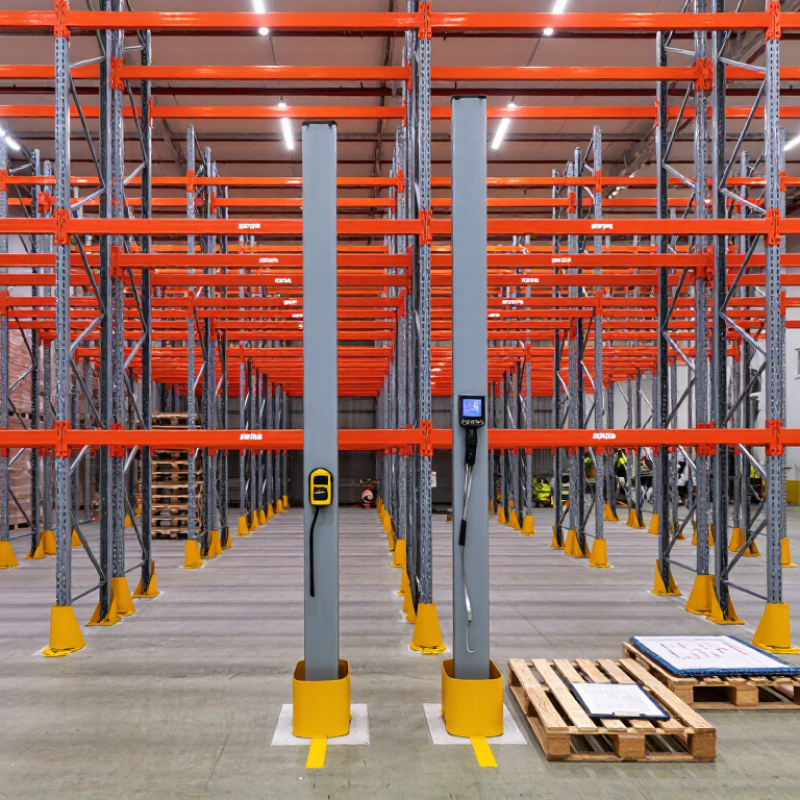
Define Design Loads: Pallet Weight, Beam Levels, and ANSI MH16.1
Before choosing storage rack uprights, identify the heaviest fully loaded pallet, not the average. Include the pallet, product, packaging, and any attachments in its weight. Record the maximum load at every beam level. A bay with four levels can carry very different loads when dense goods sit on the bottom and lighter cartons sit above. Small detail, big consequence.
ANSI MH16.1-2021, the Rack Manufacturers Institute’s specification for industrial steel storage racks, provides the design framework for evaluating rack systems. Upright capacity depends on factors including beam elevations, frame depth, bracing, and load distribution. Do not simply divide a bay’s total load by the number of uprights. The actual forces are not always shared evenly. Ask a qualified rack engineer to check the proposed layout, floor conditions, and applicable load combinations against the standard.
Operational data matters, too. MHI’s 2024 Annual Industry Report found that 55% of surveyed organizations planned to increase supply-chain technology investment. More tracking can help, but software cannot correct an inaccurate pallet weight. Weigh representative loads, flag unusually heavy pallets, and keep a written load schedule beside the rack plan. It may feel tedious. It prevents a guessed number from becoming the design basis.
How to Choose Storage Rack Uprights in 2026
Illustrative vertical pallet load per upright by beam level and pallet weight
Assumption: each beam level carries two equally loaded pallets, with their load shared equally by the two uprights in a frame. Values show pallet load only, converted to kilonewtons; rack self-weight, load placement, frame geometry, bracing, seismic effects, and other design factors are excluded. Use the applicable ANSI MH16.1 requirements and a qualified rack design professional to verify upright capacity. This chart is not a capacity rating.
Measure Bay Height, Frame Depth, and Upright Length for the Layout
Measure the clear bay height from the finished floor to the lowest obstruction, such as a sprinkler pipe, light, or ceiling beam. Check several points along the row; floors and overhead services are not always level. Measure twice. Leave clearance for installation and the loads being handled, using the rack supplier’s specifications for required spacing.
Frame depth is the front-to-back measurement of the upright frame. Match it to the pallets or containers, then check how much load will project beyond the supports. A pallet that overhangs too far can obstruct an aisle or sit poorly on the beams. Record the actual load dimensions, not just the nominal pallet size. Small errors matter.
Upright length determines the frame’s overall height, but it should fit the planned beam levels and the available clear height. Confirm that the proposed configuration meets the rack’s published load ratings; changing beam positions can affect capacity. Include base plates and any floor slope when checking the layout. One awkward corner or low pipe can force a revision, even when the main bay measurements look right. Recheck the measurements on site before ordering.
How to Choose Storage Rack Uprights in 2026 — Measure Bay Height, Frame Depth, and Upright Length for the Layout
Illustrative planning examples only. Confirm final dimensions, load ratings, clearances, and configuration with the rack supplier and applicable local requirements. | Layout example | Measured clear height | Illustrative upright length | Pallet depth | Illustrative frame depth | Layout measurement notes |
| Compact storage area | 10 ft (120 in) | 8 ft (96 in) | 40 in | 36 in | A 36-in frame leaves about 2 in of pallet overhang at the front and rear when the pallet is centered. Check the remaining height for the top load and required overhead clearance. |
| Standard-height room | 14 ft (168 in) | 12 ft (144 in) | 48 in | 42 in | A centered 48-in-deep pallet on a 42-in frame overhangs by about 3 in at each end. Verify pallet support, load stability, and any backstop or flue-space requirements. |
| Higher-capacity layout | 18 ft (216 in) | 16 ft (192 in) | 48 in | 42 in | Measure around sprinklers, lights, ducts, and other obstructions. The example leaves 2 ft between the measured envelope and upright length; this is not a universal code clearance. |
| Tall storage layout | 22 ft (264 in) | 20 ft (240 in) | 36 in | 32 in | A centered 36-in-deep pallet on a 32-in frame overhangs by about 2 in at each end. Tall frames need a design check for load, anchoring, bracing, floor conditions, and local requirements. |
Measurement checklist: Measure clear height from the finished floor to the lowest obstruction across the full rack footprint. Measure the actual loaded pallet depth, not just the pallet deck. Frame depth is the front-to-back dimension; overhang examples assume the pallet is centered. Choose upright length only after accounting for beam elevations, load height, handling clearance, and required overhead clearances. Actual rack dimensions and available upright lengths vary by system.
Check Upright Capacity with Manufacturer Tables and KL/r Buckling Data
A storage rack upright can look sturdy and still buckle under a poorly matched load. Start with the manufacturer’s capacity table for the exact frame depth, height, bracing pattern, and beam elevations. Check whether the rating applies to one upright or a complete frame. Small differences matter. A changed beam level can alter the unsupported length and reduce capacity.
Then check the column data behind the rating. KL/r is the effective column length, K times L, divided by the section’s radius of gyration, r. AISC 360-22 gives the elastic buckling relationship Fₑ = π²E/(KL/r)² and uses E = 29,000 ksi for structural steel. As KL/r rises, elastic buckling stress falls. The equation helps explain risk, but it does not replace a tested rack rating. RMI’s ANSI MH16.1-2023 addresses rack design, testing, and use; compare its design basis with the manufacturer’s table.
Look closely at the stated assumptions: steel grade, frame bracing, base restraint, anchors, and load distribution. A table may assume a level floor and properly installed connections. Your site may not match that picture. I would verify the loaded beam elevations and actual frame configuration before ordering. Not guesswork. If the table omits a condition, ask the manufacturer’s engineering team for written confirmation. KL/r is useful, but it is only one piece of the capacity check.
Specify Bracing and Seismic Loads Using ASCE 7 Design Criteria
How to Choose Storage Rack Uprights in 2026
Upright selection starts with the seismic demand at the actual site, not a generic “high-seismic” label. The USGS 2023 National Seismic Hazard Model maps spectral accelerations at 0.2- and 1.0-second periods. ASCE 7 uses mapped values, site class, and risk category to establish design forces. For rack-specific design, check the applicable edition of ANSI MH16.1 alongside ASCE 7; the governing requirements depend on rack configuration and local adoption. Small changes matter.
Bracing must transfer lateral forces through the frame, baseplates, anchors, and slab. Compare brace spacing and connection details with the calculated loads, including stored-product weight and operating conditions. A tall upright with slender diagonals may look adequate but still drift excessively. Confirm the slab’s capacity and anchor edge distances with project-specific data. FEMA P-1050-1 provides seismic design guidance and reinforces the need to account for site-dependent ground motion. Do not copy a neighboring facility’s details without checking its soil, rack geometry, and load assumptions.
Tips: Ask the engineer to document the site class, mapped Ss and S1 values, seismic design category, and brace forces. Photograph baseplates and anchors before installation; corrections are easier before the first pallet goes up. Recheck assumptions when beam levels or stored loads change. Rack layouts evolve, and that detail is easy to overlook.
Verify Anchors, Clearances, and RMI Inspection Requirements Before Use
Before selecting storage rack uprights, confirm the complete frame design, not just the upright’s published capacity. RMI’s ANSI MH16.1-2023 standard addresses the design and testing of industrial steel storage racks; actual capacity depends on configuration, bracing, beams, loads, and anchorage. Match anchor type, diameter, embedment, and installation to the engineered drawings and floor conditions. Then check aisle width, sprinkler clearance, and overhead obstructions against the approved layout. Measure on site. Drawings can miss field changes.
Inspect every connection before loading: look for bent columns, loose anchors, missing safety pins, and damaged floor concrete. RMI guidance emphasizes regular rack inspections and assessment by a qualified person; follow the inspection plan for your facility and act promptly on damage. OSHA’s 29 CFR 1910.176(b) requires stored materials to be stable and secure. The risk deserves attention: the U.S. Bureau of Labor Statistics reported 4.8 recordable cases per 100 full-time workers in warehousing and storage in 2022, versus 2.7 across private industry. Those figures cover all recordable injuries, not rack failures specifically. Keep inspection records, post load notices, and pause use when damage or anchor movement raises doubt. A minor alignment issue may be easy to overlook. It still matters.