
Best Smart Street Light Manufacturers in China
Choosing among the best Smart Street Light manufacturers in China takes more than comparing catalogue prices. A streetlight project may depend on LED efficiency, driver quality, dimming controls, sensors, and reliable communication between poles. Small details matter. A loose connector or unclear control-system specification can create avoidable maintenance work later. Specs can mislead.
This guide introduces manufacturers through practical questions buyers can verify: What products do they make in-house? Can they share test reports, component details, and clear warranty terms? Do they support the required control platform, pole configuration, and project quantity? Photos of a bright showroom are useful, but they do not prove how a system performs outdoors through rain, dust, heat, or repeated switching. Ask for evidence, and check that it matches the product being quoted.
The goal is not to declare one supplier best for every project. Different cities and contractors need different combinations of lighting output, connectivity, service support, and budget. A careful comparison should consider factory experience, product consistency, communication, and the ability to explain technical limits—not just the lowest price. Even experienced buyers can miss a detail. That is worth admitting. The following overview offers a grounded starting point for evaluating Chinese manufacturers and narrowing the field, while leaving room for project-specific checks before any purchase decision.
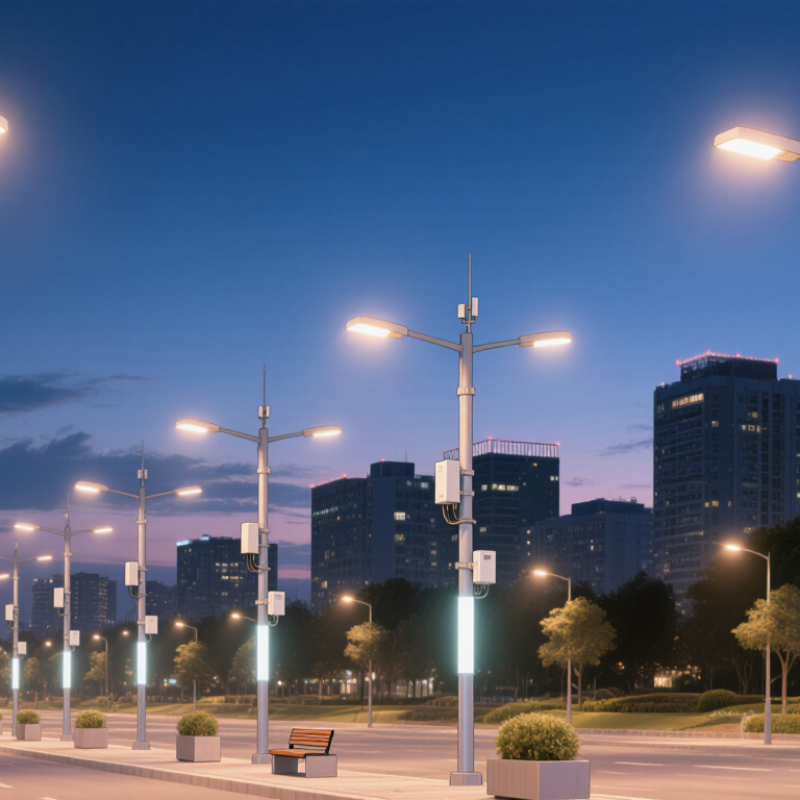
What Smart Street Lights Include and How They Work
A smart street light is more than an LED lamp on a pole. Its core parts usually include an efficient luminaire, a control unit, a communications module, and a power supply. Some systems also use motion, light, or environmental sensors. The exact combination depends on the road and the operator’s needs.
At dusk, a photocell or programmed schedule can switch the lamp on. The controller then adjusts brightness, often using a preset plan or sensor readings. For example, a quiet side street may dim late at night and brighten when movement is detected. A network connection lets operators change settings remotely and check reports such as energy use or lamp faults. Details matter.
Connected lights do not remove the need for practical checks. A sensor may misread movement near trees, while a weak signal can delay status updates. Pole spacing, road layout, and local weather also affect performance. During installation, technicians should test dimming levels and communications at the actual site, not only in a workshop. Even then, results need review. A smart system can save energy, but poor calibration may leave a crossing too dark or waste power on an empty road.
Best Smart Street Light Manufacturers in China - What Smart Street Lights Include and How They Work
| System element | What it includes | How it works | What to check when comparing manufacturers |
|---|---|---|---|
| LED luminaire | LED modules, optics, housing, and thermal-management components. | LEDs convert electrical energy into light. The optical design distributes light toward the road or target area; the heat sink helps manage operating temperature. | Request roadway photometric files and verify that the proposed layout meets the project’s applicable lighting requirements. Check ingress protection and materials for the intended environment. |
| LED driver and dimming interface | A driver matched to the LED load, with a compatible dimming or control interface where required. | The driver regulates power to the LEDs. A control signal can adjust output when the driver and control system support compatible methods, such as DALI or 0–10 V. | Confirm interface compatibility, dimming range, electrical input requirements, and replacement availability. |
| Controller or network node | A luminaire-mounted or cabinet-mounted controller, depending on the system design. | The controller receives commands or follows stored settings, then communicates with the driver to switch or dim the light. It may also report status and faults. | Check whether the control system is open or proprietary, how devices are commissioned, and which monitoring and maintenance functions are supported. |
| Communication network | A communication method selected for the site, such as RF mesh, cellular, power-line communication, or a low-power wide-area network. | Nodes send operating data and receive control instructions through the selected network. Coverage, bandwidth, and network architecture vary by technology and site conditions. | Ask for a coverage plan, network responsibilities, ongoing connectivity costs where applicable, and the procedure for operation during communication loss. |
| Sensors and photocell | Optional ambient-light sensors and, where appropriate, motion or occupancy sensors. | A photocell can trigger switching based on ambient light. Motion sensors can provide input for adaptive lighting, subject to suitable placement, settings, and local requirements. | Confirm sensor detection range, mounting position, adjustment options, and how sensor input interacts with schedules and safety requirements. |
| Management software | A web-based or locally hosted platform for device configuration, schedules, monitoring, and reporting. | Operators set lighting schedules or dimming levels, view device status, and review alerts. Available features depend on the platform and its integration options. | Review user access controls, data export, software updates, system integration, support terms, and whether the project can retain control of its data. |
| Power protection and electrical safety | Appropriately selected surge-protection devices, grounding, wiring, and protective components. | Protection components help manage electrical hazards and transient overvoltage risks when correctly specified and installed for the system. | Verify ratings and installation requirements against local electrical codes and site conditions; clarify inspection and replacement procedures. |
| Typical operating sequence | Power supply, control settings, optional sensor input, communication, and the luminaire. | The system switches on according to a schedule or light-level setting. It applies programmed output levels, may adjust them in response to sensor input, and can send operating or fault information to the management platform. | Ask manufacturers to demonstrate the full sequence, including local fallback behavior, fault reporting, commissioning, and maintenance workflows. |
Note: Smart street-light configurations vary by project. Product specifications, compatibility, certifications, and lighting performance should be verified for the exact proposed system and local requirements.